
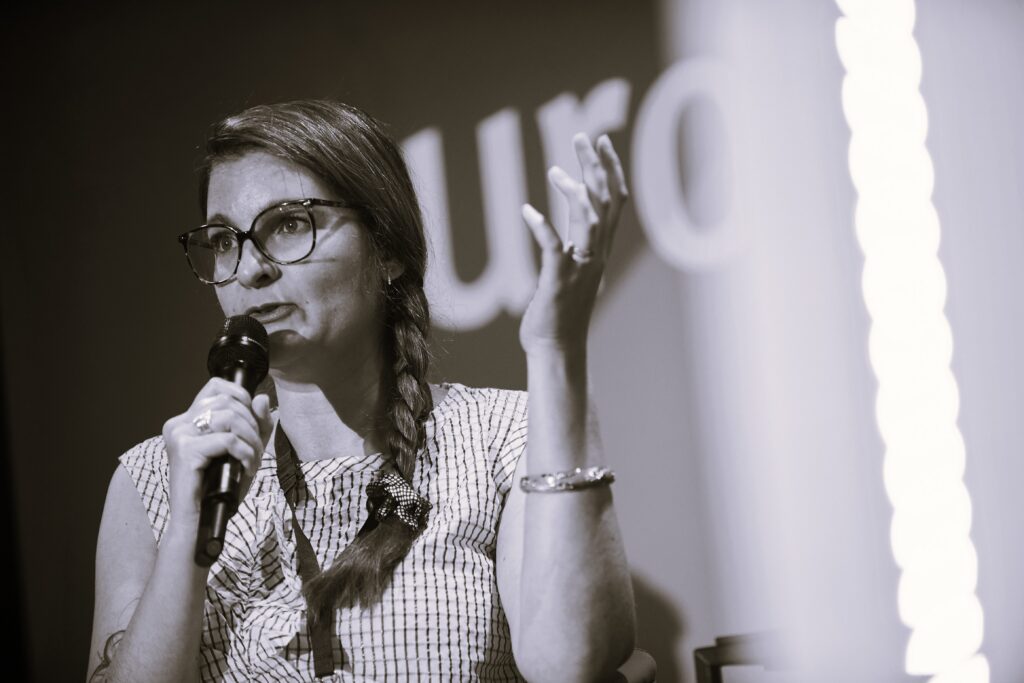
Iva Ganev, Environment and Climate Policy Manager at Glass for Europe, took part in Eurogas’ Renewable Gas Conference & Barbecue on 1 July in Brussels, highlighting the need for a diverse range of solutions to decarbonise flat glass production in Europe.
The Eurogas Renewable Gas Conference brought together stakeholders from across the energy and industrial sectors to discuss the role of renewable gases in Europe’s transition towards a more competitive and climate-neutral economy.
Speaking during the conference, Iva Ganev stressed that there are today no manufacturing technologies allowing to cut CO2 emissions on a scale compatible with the 2040 target. Therefore, in the absence of a “silver bullet” solution, EU flat glass manufacturers are exploring and investing in a range of technologies and solutions to reduce emissions. Significant work is already underway, including investments and industrial trials in areas such as electrification, with a series of world-firsts taking place in the EU. However, the complexity of the sector means that decarbonisation is likely to rely on a combination of solutions adapted to the specific needs and circumstances of individual plants.
In this context, renewable gases, including biomethane and other renewable gaseous energy carriers, can form part of the decarbonisation toolbox for flat glass production. Their role should be considered alongside other solutions, rather than as a standalone pathway to climate neutrality.
According to Iva Ganev, the challenge is not only technological, but economic, linked to both CAPEX and OPEX, in addition to aggressive competition from non-EU competitors. The flat glass industry needs a framework that enables companies to make the substantial investments required for the transition while maintaining their competitiveness in Europe.
She also highlighted the importance of the ongoing reform of the EU Emissions Trading System (EU ETS). For the flat glass industry, this means maintaining free allocation and ensuring that support mechanisms are directed towards the industrial sectors where the greatest decarbonisation investments are needed.
The transition to climate neutral flat glass production will ultimately require a combination of technologies, energy sources and supportive policies. Ensuring that industry has access to the right energy carriers, investment conditions and regulatory framework will be essential to making this transition possible while safeguarding the competitiveness of European manufacturing.
