
The European flat glass sector is key to achieving the EU’s decarbonisation goals and the recently adopted target of a 90% reduction in GHG by 2040[1].
Flat glass products help to improve the energy efficiency of buildings, support the transition to clean mobility, and contribute to efficient renewable solar energy generation. In all its applications, flat glass is an irreplaceable material whose technological advances, availability and affordability are critical to many of Europe’s flagship industries, its economic security and low-carbon future[2].
While already producing net carbon-avoidance products throughout their life cycles[3], the flat glass sector has worked tirelessly at reducing CO2 emissions from its manufacturing processes and continues to do so despite greater economic, international competition and technological constraints.
The flat glass sector’s European industrial base is nowadays being put at risk by rising energy and carbon costs, the lack of manufacturing technologies allowing to cut CO2 emissions on a scale compatible with the 2040 target, and aggressive competition from imports originating in East Asia. Combined, these challenges impede the sector’s ability to invest in upgrading its plants with Best Available Technologies and to research and pilot novel manufacturing technologies[4].
The reform of the EU ETS post-2030 offers an essential opportunity to tackle some of these challenges and to help restore a business case for sustainable flat glass manufacturing in Europe.
Key considerations
- It is of utmost urgency to design a new EU ETS framework post-2030. The existing phase IV of the EU ETS is not fit for 2030 and beyond. ETS Phase IV mechanisms imply the end of free allocation, while the 2040 target induces the rapid depletion of the carbon market. These are clear deterrents to any investment decision. Flat glass manufacturers urgently need clear rules post-2030, adequate levels of free allocation and a carbon market with enough liquidity. These are key factors to have a viable business case for sustainable production in the EU and make investment decisions on new furnaces that run for 16 to 20 years.An adequate level of protection against the risk of carbon leakage must be guaranteed. Under phase IV of the EU ETS, the flat glass sector receives free allocation up to the CO2 benchmark level due to its exposure to risks of carbon leakage. With increased imports from third countries and expected higher carbon costs, this risk will persist and likely increase. Considering that the flat glass sector’s inclusion in the Carbon Border Adjustment Mechanism (CBAM) is not envisaged in the short term, it is essential that the sector remains protected against the risk of carbon leakage and that protection increases alongside the risk. The level of protection for non-CBAM sectors must remain effective, as they do not benefit from the CBAM features.
- Free allocation should remain the prime source of protection against the risk of carbon leakage. The current system of protection against carbon leakage by way of free allocation is well established and provides protection while rewarding decarbonisation investments. This system should be safeguarded in the post-2030 period.
- Free allocation may need to be better targeted as fewer allowances will be available. The concept of conditioning free allocation to decarbonisation investments on specific sites should be discarded due to risks of administrative complexity, criteria disconnected from the realities of each sector and site, and distortions of competition within sectors. As an alternative, additional sectoral conditions could be investigated, for example the availability of decarbonisation technologies, of low-carbon feedstock and infrastructure, and the strategic contribution of the industry to the achievement of EU policy objectives.
- The new EU ETS framework must not penalise industrial investments in the hardest-to-abate sectors where technological solutions to decarbonise are not yet available. While for some sectors, the challenge lies in the deployment of existing decarbonisation solutions, no technology is available (worldwide) to allow flat glass manufacturing to reduce CO2 emissions at the level of 76% in 2040 compared to 2030 indicated by the new 2040 target[5]. Despite generating a lower CO2 emission reduction than the EU target requires, the adoption of best available technologies must be supported to curb CO2 emissions as much as technically possible. Levels of free allocation must be based on realistic and technically attainable benchmarks for the industry to be able to continue researching, testing and ultimately deploying novel manufacturing technologies as soon as they become available and economically viable.
- Continuous increase in carbon costs for flat glass manufacturing will be counter-productive to the EU decarbonisation, affordable housing and strategic autonomy agendas. While the EU ETS is underpinned by the idea that the internalisation of carbon costs will generate a switch towards materials with lower carbon content, this dynamic is not applicable to flat glass products, which are irreplaceable in most applications. Systems are therefore needed to mitigate the impacts of increased carbon costs in flat glass manufacturing to avoid making flat glass products more costly, which is at odds with Europe’s own decarbonisation target and its affordable housing agenda.
Glass for Europe believes that a reform is imperative to mitigate carbon costs, in particular for those sectors, like flat glass manufacturing, where no technological options to decarbonize exist nowadays. A business case for sustainable flat glass manufacturing in Europe must be restored to support the industry’s efforts to look for manufacturing decarbonization breakthrough.
1. Continued protection against carbon leakage
With the need to continue enabling Research and Innovation, the levels of investment required in the flat glass sector are largely amplified. At the same time, the capacity to make those investments is currently impacted by high production costs in an increasingly competitive and challenging global landscape. Flat glass production is not only capital-intensive; it is also linked to long investment cycles. A flat glass furnace functions in a continuous manner, without any possible interruption, typically for 16-20 years. During this time, only maintenance operations and limited modifications can be implemented.
- The EU flat glass sector needs the continuation of its protection against carbon leakage. The investment needs and the sector’s exposure to international trade are increasing in parallel. Flat glass will not be covered by the CBAM in the short to medium term. Therefore, it is put at a higher risk of carbon leakage and will require continued protection to preserve its contribution to the EU economy and decarbonisation objectives.
- The protection against carbon leakage should be provided through free allocation. The free allocation system is already in place, offers a good return on experience and has a proven track-record of its efficiency. It is rightly based on the exposure to carbon leakage at sectoral level. A sufficient free allocation level should be foreseen, which can be reduced proportionally to the technological and economic capacity of sectors to deploy transformative technologies. However, reducing free allocation for sectors where those decarbonisation technologies do not exist yet will automatically induce higher carbon costs and act as a deterrent to innovation and investments.
2. Adequately calibrated conditionality of support
While an increased emissions reduction target will result in a reduced volume of allowances, choices need to be made to ensure a sufficient level of free allocation to sectors which need to continue being protected in the coming years. If this support needs to be more targeted, a reflection and investigation on additional criteria to carbon leakage exposure should be conducted.
- The Market Stability Reserve (MSR) should play an active role in enabling industrial transformation. Cancellation of allowances from the MSR should be discontinued, instead allowing the use of these allowances to support the heavy investment needs in sectors without available technology to significantly reduce their emissions. This could be done in coordination with the future Industrial Decarbonisation Bank. In addition, the MSR intake and release rates should also be reviewed to ensure enough liquidity is maintained in the market.
- Support should be kept at sectoral level. If a sector is exposed to carbon leakage, then protection must also be sectoral. Disaggregating support to focus on individual installations or companies bears risks of administrative complexity, of selecting criteria disconnected from the realities of each site and sector and of distortion of competition within sectors. Instead, objective criteria need to be selected, covering all installations within a sector.
- Additional criteria, at sectoral level, need to be investigated, for example the technological capacity to decarbonise – assessed based on the availability of technologies at a high TRL level (8-9) with affordable inputs and infrastructure – or the absence of substitutes for those products necessary to the EU’s decarbonisation and strategic autonomy objectives. The availability of technologies allowing sectors to decarbonise is directly correlated to the risk of carbon leakage.
3. Support scaled-up to industrial transformation
The success of Research and Innovation programmes championed by the industry will be key for the achievement of the EU climate targets. It is imperative to the materialisation of the transition towards climate-neutrality that funds made available for industry transformation are massively scaled-up. Nowadays, less than 5% of the revenues generated by the EU ETS are used to support industrial decarbonization[6]. This number alone shows that ETS acts as a levy on those industries, i.e. a ‘stick’, but that support to their transformation, i.e. the ‘carrot’, is missing. As a principle, 100% of ETS revenues should be redirected towards industry through schemes supporting its transformation if the ETS is to become a credible instrument of green growth and manufacturing excellence in Europe.
Beyond the scale of financing made available, the channelling of funds also needs to be reviewed. More support should logically be provided to sectors which still need to bridge the transformation gap but currently lack the technology allowing them to do so. This is where the biggest physical and technical challenges lie.
- Financing for industrial transformation support schemes must be massively scaled up; the earmarking of ETS revenues for industrial transformation must also be increased and guaranteed. The ETS Innovation Fund and the future Decarbonisation Bank should be conceived as essential add-ons to the EU ETS.
- Access criteria should be adapted to the needs of the different sectors subject to the EU ETS. For instance, the EU ETS Innovation Fund should primarily focus on sectors lacking decarbonisation technologies with high TRL(s) to bridge the technology gap. Once technology is available, other instruments such as the Decarbonization Bank should be primarily used to bridge the economic gap – both CAPEX and OPEX – to accompany the deployment of those new technologies.
- In selecting projects submitted to EU funding, one should consider the strategic nature of the sector and products concerned for achieving the EU decarbonisation goals.
* * *
ANNEX 1 – EVOLUTION OF THE EU FLOAT GLASS MANUFACTURING INDUSTRY UNDER PHASE IV OF THE EU ETS
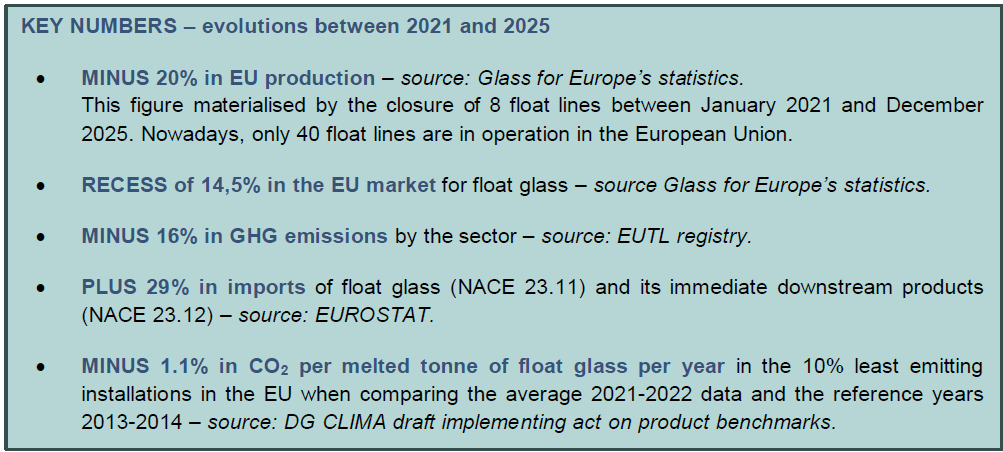
Numbers show that EU-based flat glass manufacturers were forced to reduce production during the EU ETS phase IV period by larger percentage points that the market recess: 20% loss in production while the market contracted by 14.5%.
This shows a loss of market share for EU producers that is illustrated by the increase of 29% in imports of float glass (NACE 23.11) and its immediate downstream products (NACE 23.12) from outside the European Union. The risk of carbon leakage in the sector has therefore substantially increased, if not started materialising.
This loss in competitiveness of the EU industry cannot be attributed solely to the rise in energy costs. The price of gas (TTF) in the reference year was averaging 46 EUR/MWh while in 2025 it was on average 49 EUR/MWh[7]. Other factors, including, for a part, rising carbon costs, played a role.
During the same period, total CO2 emissions from the sector decreased by 16%, mostly due to the loss in production. This number also means that float glass producers improved their processes despite efficiency losses: as declines in production are accompanied by higher CO2 emissions per output unit, remaining plants are forced to produce at lower pulls, which are less efficient.
The average CO2 per output unit in the 10% least CO2 emitting installations declined by 1.1% between the average 2021-2022 data and the reference years 2013-2014. This reduction was made possible by the refurbishment of installations using Best Available Technologies. However, this figure also demonstrates that despite its continued investments to reduce CO2 emissions, the sector does not have the technology to decarbonize in a scale compatible with the EU target.
ANNEX 2 – CURRENT FLAT GLASS MANUFACTURING PROCESS AND CO2 EMISSION TRACK RECORD
Significant efforts have already been implemented in the EU flat glass sector and further projects are underway. The EU industry has implemented numerous innovation trials including worlds firsts, with tests involving hydrogen or biofuels to power the furnaces, a carbon capture trial, an on-going project for a small-scale hybrid furnace, and the introduction of higher levels of recycled glass in the batch to lower the carbon footprint of the products.
Flat glass represents 0,12% of the total CO2 emissions in the EU (2023 figures). The emissions level has been consistently decreasing for the last decades, with the sector reaching the limits of the existing technologies’ potential.
Evolution of average CO2 emissions in the EU flat glass sector
(Glass for Europe’s membership, 2005-2023)
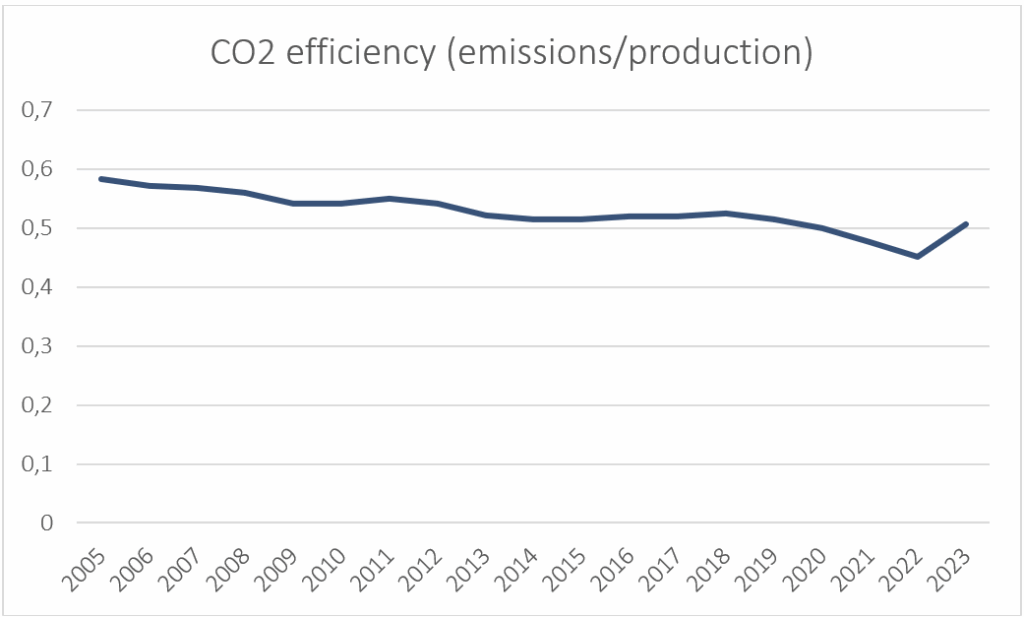
Source: Glass for Europe, based on internal production statistics and EUTL data for GHG emissions
Flat glass melting takes place in very big furnaces, over 60-meter-long, 25-meter-wide and 12-meter-high. While the typical output is 700 tonnes/day, the furnaces have a capacity of up to 2,000 tonnes.
The melting requires reaching one of the highest industrial temperatures, above 1,600°C. It is estimated that the flat glass manufacturing industry uses yearly 61.000 TJ of natural gas in its European installations, which corresponds to approximately 0.4% of the EU’s gross inland consumption (source: Glass for Europe’s estimates, Eurostat).
Flat glass furnaces use natural gas to achieve the necessary heat needed to refine raw materials. A fully electrified furnace would require considerable amounts of electricity and, at present, would not deliver the necessary glass quality level. To elaborate in simple terms: a flame is needed to ‘polish’ the glass surface.
Process emissions represent around 25% of the total emissions from flat glass making. They are linked to the carbon content of raw materials and are typically irreducible. The only way to achieve a notable decline in this share of CO2 emissions is to introduce a higher level of glass cullet (recycled glass) in the furnace.
Flat glass making is a continuous process, functioning 24/7, 365 days per year. An uninterrupted supply of energy is needed to keep the flat glass furnace at the required temperature, for the proper functioning and safety of flat glass manufacturing installations. Changes in temperature generate stress on the refractory bricks, which constitute the shell of the melting furnace, and thus increase risk of industrial hazards.
The flat glass sector is characterised by long investment cycles, with a furnace typically lasting 16-20 years.
Fundamental changes to the furnace, such as the deployment of a new technology, can only be implemented at the end of the lifetime of the furnace, once it has been progressively cooled down to allow its safe dismantling.

ANNEX 3 – LACK OF TECHNOLOGY TO MASSIVELY DECARBONISE FLAT GLASS PRODUCTION
Glass for Europe’s members are committed to continue delivering improvements in the manufacturing process to the utmost of their capabilities. However, the current state of the art technology does not allow to achieve significant reductions of CO2 emissions.
Today, there is no technology available for flat glass manufacturing allowing it to bridge the gap to carbon neutrality by 2050.
A recent Compass Lexecon study[8] for the Enel Foundation recognises that flat glass production is characterised by very high temperatures and process heat requirements. Flat glass making is associated to high technological and economic barriers.
The study finds that only one direct electrification solution could be technically available as a low-carbon technology at scale, only after 2040: resistance heating. As for indirect electrification solutions, hydrogen and biomass are considered, however the flat glass industry, as other sectors, is dependent on their availability and affordability. Hybrid furnaces could also be a possible solution for significant reduction of CO2 emissions. This pathway is actively explored by the EU flat glass sector, with the first testing project ongoing since February 2025[9]. The trials, which are taking place on a small-scale furnace, are expected to last until 2028. If successful, a scaling of this technology to the typical flat glass furnace size would have to be implemented on a selected flat glass site and again tested, before possibly envisaging deployment.
The study also concludes to a substantial cost gap between fossil-based and low-carbon technologies, finding that both CAPEX and OPEX incentives would be needed to tie industrial realities and policy objectives together.


Another study[10], written by Institut Rousseau and supported by the European Parliament’s Greens Group, has looked into what is needed to put Europe on the path to climate neutrality, while keeping Europe in the global race for competitiveness, in line with the EU’s strategic autonomy agenda. Several industrial sectors are analysed, including glass. The study confirms that the possible decarbonisation pathways for this sector are material efficiency, described as increased use of glass cullet (recycled glass) in the furnace, and energy mix decarbonation, presented as increased biogas/biomass utilisation.
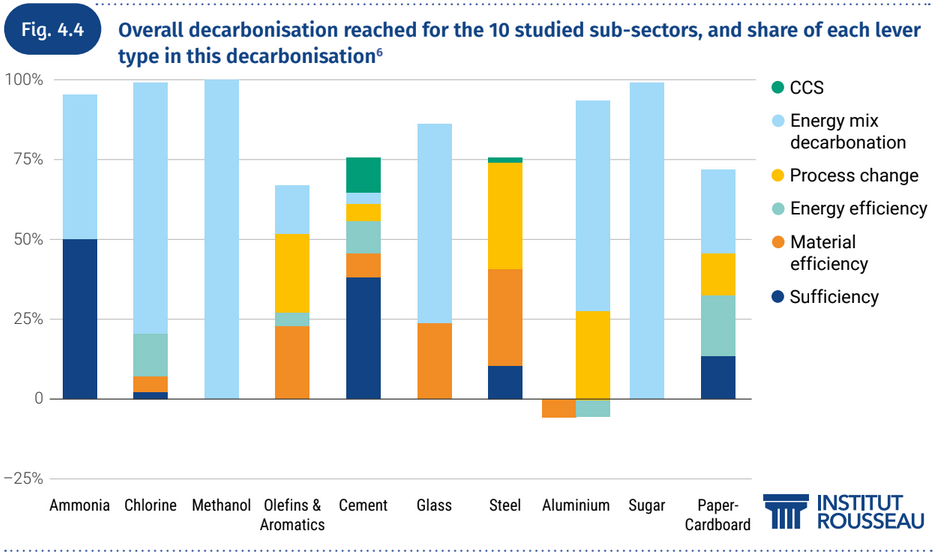
The study finds that the total investment needs for glass sectors in the EU by 2050 are 3.8 billion euros (flat glass represents approximately 35% of all glass sectors in volume).
* * *
[1] Amended EU Climate Law
[2] Glass for Europe – 2050 I Flat glass in a climate neutral Europe – 2020
[3] Up to 37% of the total energy consumption in the EU building stock can be saved in 2050 thanks to high-performance glazing products – TNO Built Environment and Geosciences, 2019
[4] See Annex 1 – Evolution of the EU flat glass manufacturing industry under phase IV of the EU ETS
[5] European Commission’s Impact Assessment on 2040 target, part 3/5, page 68. Such a figure is unattainable with the current most sustainable technologies in the flat glass sector – see Annex I to this paper.
[6] Source: DG CLIMA figure presented at the 12 May 2026 High-level stakeholder forum on the EU ETS post-2030.
[7] Source for gas prices: https://tradingeconomics.com/commodity/eu-natural-gas
[8] Compass Lexecon study, Reviving Europe’s Industrial Power: How to boost competitiveness through energy, December 2024, https://www.enelfoundation.org/topics/articles/2024/11/potential-and-benefits-direct-indirect-electrification-eu-industry
[9] Volta project, https://www.agc-glass.eu/en/sustainability/hybrid-mid-sized-pilot-furnace-for-flat-glass
[10] Institut Rousseau, Road to Net Zero, January 2024, https://institut-rousseau.fr/road-2-net-zero-en/
